
Further notes about the morphostasis concept – split files
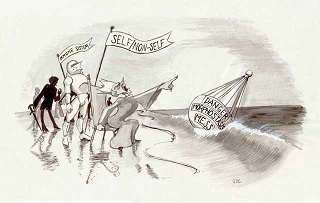
(77) Self/non-self discrimination is NOT dead (but it was naïvely misconceived).
The naïve assumption of the traditional "self/non-self" concept of discrimination by the immune system was formulated around epitopes. These are roughly equivalent to antigens. The concept was that these were categorised into those occurring as "part of self structures" versus "all of the rest". Lymphocytes capable of reacting aggressively to self epitopes were assumed to be deleted in utero through the thymic processing of emerging T-cells. "All the rest" were fair game to develop into aggressive immune responses. This did NOT explain "self/nonself" discrimination by B-cells.
An epitope is a specific term ("coined" – I believe – by Neils Jerne) referring to the antibody interaction site. This is how Google AI describes an epitope (partly sourced from Wikipedia, I think):
The typical antibody-antigen interaction involves a contact surface area of approximately 10 to 20 square nanometers (nm²), (or) between 1,000 and 2,000 square angstroms (Ų). This interface typically involves about 15-25 amino acid residues on each side of the interaction (the antibody's paratope and the antigen's epitope). Key Dimensions of the Interaction: Interface Surface Area: The area where the two molecules physically interact typically measures about 1,000-2,000 Ų (10-20 nm²). Epitope Size: The specific region on the antigen (the epitope) that an antibody recognizes and binds to is generally composed of 4 to 8 amino acid residues (or 3-4 sugar residues for carbohydrate antigens). For larger protein antigens, the epitope can consist of up to 25 amino acids on the surface, which are often not continuous in the primary sequence but brought together by the protein's 3D folding. Paratope Size: The combining site on the antibody (the paratope) is similarly sized, typically comprising an average of about 15-16 residues (around 12 of which are in the hypervariable, or complementarity-determining regions). The interaction itself is a non-covalent, highly specific lock-and-key fit, involving various short-range forces like van der Waals forces, hydrogen bonds, and electrostatic interactions, and all of these depend heavily on the close fit and chemical complementarity of the two surfaces.
Now, this is important because it reflects the original predilection of the primaeval immunoglobulin superfamily of receptors that were "intent" on "recognising" cell surface identity displays (molecules) that gave rise to a variegated pool of identity structures. These enabled allo-recognition. Allo-recognition can be explained as the T-cell's preoccupation with recognising a pool of self-species major histocompatability antigens. They don't recognise non-self-species ligands; they recognise identity structures that are "deliberately" variegated (probably and originally) to inhibit pathogenic organisms from easily mimicking zygote (derived) identity membrane "flags" (ligands). Within an ecosystem of self-species, these allo-antigens appear to be useful for intra-species colony competition. The latter may well have evolved to enable better adapted individuals to competetively suppress less well adapted individuals, so establishing flourishing "self" colonies.
Now, the peptide debris that takes up residence in the peptide groove of self Mhc molecules (effectively) allows the subtle alteration of self-Mhc molecules so that they look like a population of allo-Mhc molecules and, thus, they take advantage of this primaeval precoccupation with the allo-recognition of cell surface identity molecules.
Self/non-self recognition – far from being dead – is at the core of T-cell recognition but it is based on iso-Mhc/allo-Mhc discrimination. Since xeno-Mhc recognition is effectively nil, this plays virtually no part in T-cell activation. And these Mhc molecules are not the only identity system employed by cells to help their interaction. There are a whole panoply of the "lock and fit" identity molecules used to help cells recognise each other and interact appropriately. These are the molecules that enable embryo cells to sort themselves out and to move to and act in an appropriate manner.
Far from self-nonself discrimination being "dead", it is a core mechanism used by all multicellular eucaryotes and probably many of the other extant, independent living organisms. BUT, it has nothing to do with the naïve assumption that all epitopes are classified into self or non-self.
So, self/non-self recognition is not "dead". It sits at the core of whole cell recognition, embryogensis and tissue regeneration. It is also the basis of T-cell recognition but this is based on iso-Mhc/allo-Mhc discrimination. Since xeno-Mhc recognition can be virtually nil, this plays little part in T-cell activation.